 Add to Chrome
 Add to Firefox
 Add to Edge
MSAVBench: Towards Comprehensive and Reliable Evaluation of Multi-Shot Audio-Video Generation
May 19, 2026
Video generation is rapidly evolving from single-shot synthesis to complex multi-shot audio-video (MSAV) narratives to meet real-world demands. However, evaluating such frontier models remains a fundamental challenge. Existing benchmarks are limited in scope and data diversity, and rely on rigid evaluation pipelines, preventing systematic and reliable assessment of modern MSAV models. To bridge these gaps, we introduce MSAVBench, the first comprehensive benchmark and adaptive hybrid evaluation framework for multi-shot audio-video generation. Our benchmark spans four key dimensions, video, audio, shot, and reference, covering diverse task settings, varying shot counts of up to 15, and challenging non-realistic scenarios. Our evaluation framework improves robustness through an adaptive self-correction mechanism for shot segmentation, instance-wise rubrics for subjective metrics, and tool-grounded evidence extraction for complex judgments. Furthermore, MSAVBench achieves high alignment with human judgments, reaching a Spearman rank correlation of 91.5%. Our systematic evaluation of 19 state-of-the-art closed- and open-source models shows that current systems still struggle with director-level control and fine-grained audio-visual synchronization, while modular or agentic generation pipelines offer a promising path toward narrowing the gap between open- and closed-source models. We will release the benchmark data and evaluation code to facilitate future research.

DiffusionOPD: A Unified Perspective of On-Policy Distillation in Diffusion Models
May 14, 2026Reinforcement learning has emerged as a powerful tool for improving diffusion-based text-to-image models, but existing methods are largely limited to single-task optimization. Extending RL to multiple tasks is challenging: joint optimization suffers from cross-task interference and imbalance, while cascade RL is cumbersome and prone to catastrophic forgetting. We propose DiffusionOPD, a new multi-task training paradigm for diffusion models based on Online Policy Distillation (OPD). DiffusionOPD first trains task-specific teachers independently, then distills their capabilities into a unified student along the student own rollout trajectories. This decouples single-task exploration from multi-task integration and avoids the optimization burden of solving all tasks jointly from scratch. Theoretically, we lift the OPD framework from discrete tokens to continuous-state Markov processes, deriving a closed-form per-step KL objective that unifies both stochastic SDE and deterministic ODE refinement via mean-matching. We formally and empirically demonstrate that this analytic gradient provides lower variance and better generality compared to conventional PPO-style policy gradients. Extensive experiments show that DiffusionOPD consistently surpasses both multi-reward RL and cascade RL baselines in training efficiency and final performance, while achieving state-of-the-art results on all evaluated benchmarks.
AIBench: Evaluating Visual-Logical Consistency in Academic Illustration Generation
Mar 31, 2026Although image generation has boosted various applications via its rapid evolution, whether the state-of-the-art models are able to produce ready-to-use academic illustrations for papers is still largely unexplored. Directly comparing or evaluating the illustration with VLM is native but requires oracle multi-modal understanding ability, which is unreliable for long and complex texts and illustrations. To address this, we propose AIBench, the first benchmark using VQA for evaluating logic correctness of the academic illustrations and VLMs for assessing aesthetics. In detail, we designed four levels of questions proposed from a logic diagram summarized from the method part of the paper, which query whether the generated illustration aligns with the paper on different scales. Our VQA-based approach raises more accurate and detailed evaluations on visual-logical consistency while relying less on the ability of the judger VLM. With our high-quality AIBench, we conduct extensive experiments and conclude that the performance gap between models on this task is significantly larger than general ones, reflecting their various complex reasoning and high-density generation ability. Further, the logic and aesthetics are hard to optimize simultaneously as in handcrafted illustrations. Additional experiments further state that test-time scaling on both abilities significantly boosts the performance on this task.
ST4VLA: Spatially Guided Training for Vision-Language-Action Models
Feb 10, 2026Large vision-language models (VLMs) excel at multimodal understanding but fall short when extended to embodied tasks, where instructions must be transformed into low-level motor actions. We introduce ST4VLA, a dual-system Vision-Language-Action framework that leverages Spatial Guided Training to align action learning with spatial priors in VLMs. ST4VLA includes two stages: (i) spatial grounding pre-training, which equips the VLM with transferable priors via scalable point, box, and trajectory prediction from both web-scale and robot-specific data, and (ii) spatially guided action post-training, which encourages the model to produce richer spatial priors to guide action generation via spatial prompting. This design preserves spatial grounding during policy learning and promotes consistent optimization across spatial and action objectives. Empirically, ST4VLA achieves substantial improvements over vanilla VLA, with performance increasing from 66.1 -> 84.6 on Google Robot and from 54.7 -> 73.2 on WidowX Robot, establishing new state-of-the-art results on SimplerEnv. It also demonstrates stronger generalization to unseen objects and paraphrased instructions, as well as robustness to long-horizon perturbations in real-world settings. These results highlight scalable spatially guided training as a promising direction for robust, generalizable robot learning. Source code, data and models are released at https://internrobotics.github.io/internvla-m1.github.io/
Aligned Stable Inpainting: Mitigating Unwanted Object Insertion and Preserving Color Consistency
Jan 21, 2026Generative image inpainting can produce realistic, high-fidelity results even with large, irregular masks. However, existing methods still face key issues that make inpainted images look unnatural. In this paper, we identify two main problems: (1) Unwanted object insertion: generative models may hallucinate arbitrary objects in the masked region that do not match the surrounding context. (2) Color inconsistency: inpainted regions often exhibit noticeable color shifts, leading to smeared textures and degraded image quality. We analyze the underlying causes of these issues and propose efficient post-hoc solutions for pre-trained inpainting models. Specifically, we introduce the principled framework of Aligned Stable inpainting with UnKnown Areas prior (ASUKA). To reduce unwanted object insertion, we use reconstruction-based priors to guide the generative model, suppressing hallucinated objects while preserving generative flexibility. To address color inconsistency, we design a specialized VAE decoder that formulates latent-to-image decoding as a local harmonization task. This design significantly reduces color shifts and produces more color-consistent results. We implement ASUKA on two representative inpainting architectures: a U-Net-based model and a DiT-based model. We analyze and propose lightweight injection strategies that minimize interference with the model's original generation capacity while ensuring the mitigation of the two issues. We evaluate ASUKA using the Places2 dataset and MISATO, our proposed diverse benchmark. Experiments show that ASUKA effectively suppresses object hallucination and improves color consistency, outperforming standard diffusion, rectified flow models, and other inpainting methods. Dataset, models and codes will be released in github.
VidSplice: Towards Coherent Video Inpainting via Explicit Spaced Frame Guidance
Oct 24, 2025Recent video inpainting methods often employ image-to-video (I2V) priors to model temporal consistency across masked frames. While effective in moderate cases, these methods struggle under severe content degradation and tend to overlook spatiotemporal stability, resulting in insufficient control over the latter parts of the video. To address these limitations, we decouple video inpainting into two sub-tasks: multi-frame consistent image inpainting and masked area motion propagation. We propose VidSplice, a novel framework that introduces spaced-frame priors to guide the inpainting process with spatiotemporal cues. To enhance spatial coherence, we design a CoSpliced Module to perform first-frame propagation strategy that diffuses the initial frame content into subsequent reference frames through a splicing mechanism. Additionally, we introduce a delicate context controller module that encodes coherent priors after frame duplication and injects the spliced video into the I2V generative backbone, effectively constraining content distortion during generation. Extensive evaluations demonstrate that VidSplice achieves competitive performance across diverse video inpainting scenarios. Moreover, its design significantly improves both foreground alignment and motion stability, outperforming existing approaches.
Re$^3$Sim: Generating High-Fidelity Simulation Data via 3D-Photorealistic Real-to-Sim for Robotic Manipulation
Feb 12, 2025Real-world data collection for robotics is costly and resource-intensive, requiring skilled operators and expensive hardware. Simulations offer a scalable alternative but often fail to achieve sim-to-real generalization due to geometric and visual gaps. To address these challenges, we propose a 3D-photorealistic real-to-sim system, namely, RE$^3$SIM, addressing geometric and visual sim-to-real gaps. RE$^3$SIM employs advanced 3D reconstruction and neural rendering techniques to faithfully recreate real-world scenarios, enabling real-time rendering of simulated cross-view cameras within a physics-based simulator. By utilizing privileged information to collect expert demonstrations efficiently in simulation, and train robot policies with imitation learning, we validate the effectiveness of the real-to-sim-to-real pipeline across various manipulation task scenarios. Notably, with only simulated data, we can achieve zero-shot sim-to-real transfer with an average success rate exceeding 58%. To push the limit of real-to-sim, we further generate a large-scale simulation dataset, demonstrating how a robust policy can be built from simulation data that generalizes across various objects. Codes and demos are available at: http://xshenhan.github.io/Re3Sim/.
SparseGrasp: Robotic Grasping via 3D Semantic Gaussian Splatting from Sparse Multi-View RGB Images
Dec 03, 2024Language-guided robotic grasping is a rapidly advancing field where robots are instructed using human language to grasp specific objects. However, existing methods often depend on dense camera views and struggle to quickly update scenes, limiting their effectiveness in changeable environments. In contrast, we propose SparseGrasp, a novel open-vocabulary robotic grasping system that operates efficiently with sparse-view RGB images and handles scene updates fastly. Our system builds upon and significantly enhances existing computer vision modules in robotic learning. Specifically, SparseGrasp utilizes DUSt3R to generate a dense point cloud as the initialization for 3D Gaussian Splatting (3DGS), maintaining high fidelity even under sparse supervision. Importantly, SparseGrasp incorporates semantic awareness from recent vision foundation models. To further improve processing efficiency, we repurpose Principal Component Analysis (PCA) to compress features from 2D models. Additionally, we introduce a novel render-and-compare strategy that ensures rapid scene updates, enabling multi-turn grasping in changeable environments. Experimental results show that SparseGrasp significantly outperforms state-of-the-art methods in terms of both speed and adaptability, providing a robust solution for multi-turn grasping in changeable environment.
Polaris: Open-ended Interactive Robotic Manipulation via Syn2Real Visual Grounding and Large Language Models
Aug 15, 2024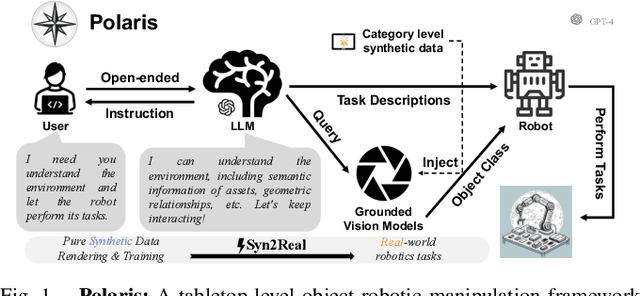


This paper investigates the task of the open-ended interactive robotic manipulation on table-top scenarios. While recent Large Language Models (LLMs) enhance robots' comprehension of user instructions, their lack of visual grounding constrains their ability to physically interact with the environment. This is because the robot needs to locate the target object for manipulation within the physical workspace. To this end, we introduce an interactive robotic manipulation framework called Polaris, which integrates perception and interaction by utilizing GPT-4 alongside grounded vision models. For precise manipulation, it is essential that such grounded vision models produce detailed object pose for the target object, rather than merely identifying pixels belonging to them in the image. Consequently, we propose a novel Synthetic-to-Real (Syn2Real) pose estimation pipeline. This pipeline utilizes rendered synthetic data for training and is then transferred to real-world manipulation tasks. The real-world performance demonstrates the efficacy of our proposed pipeline and underscores its potential for extension to more general categories. Moreover, real-robot experiments have showcased the impressive performance of our framework in grasping and executing multiple manipulation tasks. This indicates its potential to generalize to scenarios beyond the tabletop. More information and video results are available here: https://star-uu-wang.github.io/Polaris/